martes, 17 de mayo de 2016

Una nueva herramienta para nuestra FLIPPED CLASSROOM con ERASMUS+: SMORE


Durante este curso los alumnos de 1º de Bachillerato B del Instituto Francisco Salzillo han descubierto una nueva herramienta que ha facilitado el proceso de recopilación, tratamiento y presentación de la información: Smore.

Pero, vamos por partes: ¿Qué es Smore y para qué sirve?

Es una de las herramientas que ofrece la web 2.0 para publicar contenido en forma de página web.  Para los docentes, es una herramienta con grandes posibilidades en el aula, es sencilla de utilizar y con un resultado visualmente estupendo. Smore es una herramienta gratuita, solo es necesario registrase para comenzar a crear folletos y páginas web. Es muy práctica para presentar trabajos de clase sea cual sea nuestra materia. Los trabajos se comparten fácilmente en la red gracias a la URL y el código de embebido.

Las ventajas que ofrece son muchas:

·         Es muy fácil de usar porque ofrece unos iconos muy claros y muy intuitivos.
·         Ofrece la posibilidad de insertar todo tipo de archivos multimedia (audios, vídeos, gráficos, etc.)
·         Ofrece plantillas prediseñadas o la posibilidad de crear tu propia plantilla de acuerdo con el objetivo que se persiga ya que permite hacer folletos, anuncios, revistas digitales, etc.
·         El resultado es muy atractivo.
·         Es una herramienta gratuita aunque también tiene una versión más completa de pago
Este es el aspecto que presenta en su inicio:


Utilidades  didácticas:

§  Podemos utilizar Smore como cuaderno virtual para que nuestros alumnos presenten trabajos durante el curso. 
§  Crear trabajos con contenido multimedia: Álbumes de fotos, recopilación de reportajes en vídeo, comentarios de textos, audiciones musicales, etc.
§  Crear revistas digitales con los trabajos de los alumnos. Publicar anuncios de eventos del centro, carteles virtuales sobre actividades y salidas didácticas, etc.
§  Publicaciones de unidades didácticas, planteamiento de trabajos, propuestas de actividades, explicaciones de tareas, tutoriales, etc.
Los alumnos este curso lo han usado sobre todo como soporte para las exposiciones orales sobre temas de literatura y, la verdad, el resultado ha sido muy satisfactorio. Desde que han descubierto esta herramienta la han utilizado en otras asignaturas con mucho éxito.
Aquí os dejo algunos ejemplos:

https://www.smore.com/q93he Aquí está el enlace de un trabajo muy bueno que han hecho: Miriam Lorente, Sara Martínez y Laura Martínez.

https://www.smore.com/eyfbh y este otro realizado por Leopoldo Santiago,
José Carlos Ruiz y Lara Buendía.

Nota: Los murales se pueden embeber en el blog. Una vez pinches en el enlace tienes el código de embeber.

Dª Dolores Martínez
Profesora de Lengua castellana y Literatura
IES Francisco Salzillo


jueves, 12 de mayo de 2016

Kahoot: the new interactive tool in our classes

It is well known that the students nowadays tend to be more interested in new forms of teaching or evaluation instead of the traditional ones. There are also both a growing demand and a well-established reality for the majority of millennial students to be technologically literate and use the new technologies, such as PCs, laptops, tablets, or their proper cell phones on a 24 to 7 basis.
The platform of Kahoot has come to help the teachers create in a very friendly, simple and “catchy” environment, tools for teaching or evaluation, reinforcing the need of the students for “good” competition, fair play as well as staying tuned with their habitual use of electronic devices.  By entering the site https://getkahoot.com the teacher can create an account and use one of the thousands existing Kahoots quizzes or make their own one. The site provides a handy path for the educators to write their questions and subsequently to indicate the right answers. It can also use images which can be present during the display of the questions, helping or being part of the question. Through this series of steps, the teachers can create a questionnaire with a number of close type questions (Multiple choice or True/False) which can be played in either a prefixed or in a random order. There are also several features subject to change like for example the given time for each answer, or the random possible answers.
Time to play! In the class, each student or group of students has their own PC, or tablet, or even their own cell phones (provided with Wi-Fi, or with data by their carrier). The teacher visits getkahoot.com and then by choosing a questionnaire Kahoot gives a PIN number, which is shown on a smartboard or with the help of a projector to the whole class. Then, each student or group inserts the correct PIN at the web site http://kahoot.it and a nickname, using their own devices. Kahoot shows the question and the possible answers, each one combined with a specific color and shape. In real time the students can see the same colors and shapes as possible answers displayed on their screens, so they can choose the one they believe as correct. The faster they respond the more points they get (on condition that they provide the right answers). At the end of each question they can see their ranking at the main screen for the first five places. At the end of the game they can evaluate the quiz as well, so the teachers are able to see if the quiz was successful or not.
Kahoot engages students in a fair play process and in a collaborative disposition towards the rest of the team members giving thus an immense boost up in the educational process, since students that seem less daring inside a traditional class now participate as equal players of an innovative “edutainment system”.
So, let’s kahoot!


Haris Dimitrakopoulos
Biology & Spanish Language Teacher

Experimental General Lyceum of Heraklion


martes, 26 de abril de 2016

A contact with Elementary School of Saint Myron

Morning of Thursday, 8th of October 2015, and we have come to the highest summit of the cliff where the village "Saint Myron" is located. At that spot, the Elementary School is built. Its manpower sums up 3 teachers and about 50 students who come from Saint Myron and the surrounding villages Pentamode, Petrokefalo, Pyrgou. A well-preserved old classical building, with thick walls, big doors and windows, spacious rooms and an impressive court yard with ancient stones and inscriptions -the ruins of Ancient Raucous, indicates the historical character of the place. At this beautiful place, the School's Head Master Mr. Michalis Kotrotsios, the two teachers Mrs. Despoina Manouseli and Mrs. Katerina Mayiopoulou and quite many small groups of impatient students gave us a warm welcome.
For the first two hours, we gathered at a spacious room which soon became overcrowded, filled with too many seats and the total number of the School's students. Our mission was to travel along with the Earth to its Yearly Space Trip and to be acquainted with the reason for the four Seasons and the change of the day length (from Sunrise to Sunset). Assisted by media (videos and interactive applications), we studied these phenomena in all widths and lengths of the Earth, but also as viewers from Space -a role we played in a theatrical play.
A small break and we moved to the world of Maths. A and B classes learned the first powers of number 2, namely numbers 1, 2, 4 and 8, by folding in half paper sheets again and again. The game "Guess my number" followed, according to which a student thinks of a number from 1 up to 15 and then another student guesses the number by the mere information on which out of four tables it belongs. All students became excited and eager to learn the "trick" and then apply it: It was just to add the first number of each of those tables the secret number belonged to. But the fun reached its peak with the "magic cards". They were "Magic" for two reasons: they opened from the middle of the card revealing two more hidden pages and also some images changed their order (the left would come on the right and the right on the left) as the card was flipped. Of course, the little students didn't omit to color their cards, enjoying the task totally and showing their work when they were done!
Next, was C and D classes’ turn. Being a bit older, they were involved with the original "Guess my number" game which includes 5 tables with numbers from 1 up to 31. Students filled carefully a relevant worksheet and so they learned that the powers of 2 are just enough to express each number as the sum of them (the binary arithmetic system). Magic cards were shared to all of the students at the end of the hour, but unfortunately, there was no time left to explain their construction. Even so, we were truly forced by the students to briefly demonstrate the construction during the break -so eager they were to learn!
We finally met the students from E and F classes, who also filled the worksheet for the game "Guess my number". They felt quite free to move around and soon we were impressed to see one student here helping his fellow student and some others there having turned their chairs and formed small groups of 4 to cooperate!
The time was up and we left the School. As we scrolled down the little narrow village roads, some villagers informed us they had already learned about the magic cards from our students. What a wonderful feeling this was! Our lesson had flown out of the walls of our school to the neighborhoods and coffee huts through our students who had become teachers for a while. We thank you so much, our dear little friends! See you next year!


 Irini Perissinaki (Mathematics teacher)
- Irini Kassotaki (Greek language teacher)

Experimental General Lyceum of Heraklion


For more, visit the webpage "Math Laboratory" (Experimental Schools of Heraklion):  http://mathlab.mysch.gr/friends/2015_agios_myron/index_en.html

viernes, 25 de marzo de 2016

Teaching English through Biology or Biology through English?


As there is constant need for creative teaching and collaboration in our school, the Biology and the English teacher of the Experimental General Lyceum of Heraklion have decided to implement CLIL in their classes wishing to combine English and Biology. But what is CLIL (Content and Language Integrated Learning)?
According to Marsh 1 “CLIL refers to situations where subjects, or parts of subjects, are taught through a foreign language with dual-focused aims, namely the learning of content, and the simultaneous learning of a foreign language". 
CLIL contributes to both language teaching and to the learning of content enabling learners to feel more confident. Moreover, it enables students to realize the necessity of language learning in relation to fields of study they are compelled to fully comprehend or wish to pursue in the future. Students are acquainted with real content and authentic materials especially designed to aid understanding of both content and terminology.
In our case, students of the second grade of Experimental General Lyceum of Heraklion were exposed to a video explaining  ‘when exactly we are considered dead’ using Biology terms and offered a unique opportunity to practice listening, speaking and note-taking skills. The worksheet was carefully designed to offer ample practice of the above mentioned skills and motivated the students to participate in the learning process more actively.

by Maria Pitsaki, English Teacher
& Haris Dimitrakopoulos, Biology Teacher
Experimental General Lyceum of Heraklion

1 2002, Content and Language Integrated Learning: The European Dimension – Actions, Trends and Foresight Potential

domingo, 13 de marzo de 2016

EMOTIONAL INTELLIGENCE


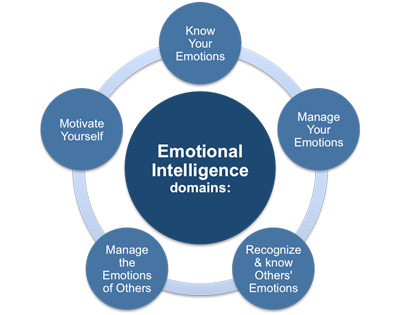
Emotional intelligence is a relatively new concept which has entered strongly in various fields such as business and education. Goleman defines it as “the ability to recognize our own feelings and those of others, for motivating and managing emotions well in ourselves and in our relationships.”

We often see how people with higher IQs are not necessarily the best succeed in different fields of life. The less genetically determined emotional intelligence than IQ, significantly affects the vital success, as this depends on the management of our emotions.

Thus, children with higher emotional intelligence have the following characteristics:
They learn more and better.
They have fewer behaviour problems.

They feel better about themselves.
They better resist peer pressure.
They are less violent and more empathetic.
They do well in conflict resolution.
They are happier, healthier, and more successful.

Therefore, in teaching practice, promoting emotional intelligence should be conducted in a coordinated promotion of the other capabilities.

This requires that teachers also develop their own emotional intelligence, as it is inevitably reflected in their teaching. This is especially important because children are "emotional sponges".

An interesting exercise that the teacher could use with their students would be to ask for an assessment of how they feel about the own teacher, in the following categories: accepted, controlled, fearful, criticised, judged, admired, respected, supported, understood and, finally, valued.

The answers can serve to increase the teacher’s efforts to help his students feel confident, necessary, important, respected, listened to, safe, supported, understood, appreciated and valued. Before trying to be understood, the teacher must seek to understand, showing sympathetic and empathetic.
 
Both teachers and students must:
Learn to label feelings, instead of people or situations .
Analyze own feelings, rather than the actions or motives of others.
Ask others how they feel.
Reflect on their own feelings.
Identify desires and fears.
Identify unmet emotional needs.
Be responsible for own emotions and happiness, avoiding the belief that other people are responsible for their own sensations.
Do not expect others make you happy.
Express their emotions.
Be consistent with their own feelings.

Generally negative feelings are an expression of unmet emotional needs, but every negative feeling has a positive value. Becoming aware of them is the key to self-knowledge and this in turn is essential for the improvement processes.

Jesús Mariano Llamas Sevilla
Jefe de Departamento de Filosofía
IES Francisco Salzillo

domingo, 28 de febrero de 2016

Last news in Crete!!!!

 Nuestra compañera Guiomar Patiño, profesora de griego y latín del IES Francisco Salzillo,  ha estado trabajando con los alumnos de 1º de Bachillerato, los mitos clásicos de origen cretense.

Junto con sus alumnos le ha dado forma de periódico digital , al que han llamado, Las sandalias de Hermes.

Aquí os dejamos el enlace para que podáis leerlo.

 Our colleague Guiomar Patiño, Latin and Greek teacher, in the high school Francisco Salzillo,has been working with her students different myths.

Latest news in Crete!!!